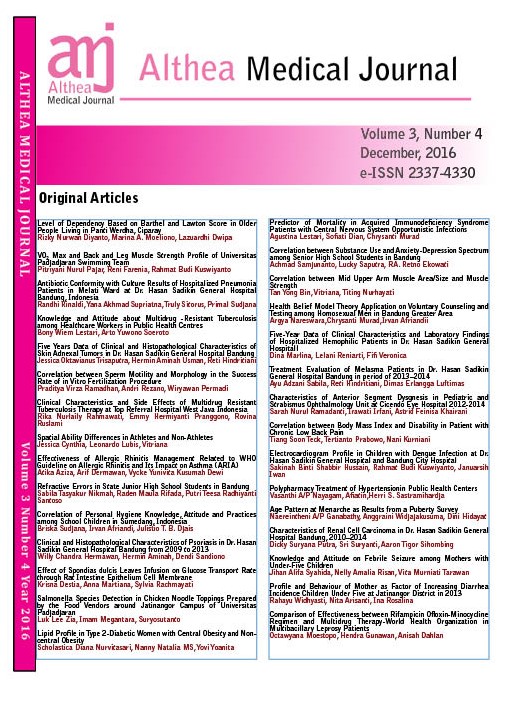
Correlation between Sperm Motility and Morphology in the Success Rate of in Vitro Fertilization Procedure
Keywords:
Fertilization rate, in vitro fertilization, sperm morphology, sperm motilityAbstract
Background: In vitro fertilization (IVF) is one of the assisted reproductive technology that has been used in treating infertility. Unfortunately, not every IVF procedure achieves 100% success in fertilizing the oocyte. It has been studied that the percentage of normal motile sperm and percentage of normal sperm morphology play a key role in this process. This study was conducted to evaluate correlation between sperm motility and morphology in the success rate of IVF.
Methods: This study was an observational analytic involving medical records of infertile couples who were treated by IVF procedure in Dr.Hasan Sadikin General Hospital Bandung in 2009–2014. The variables that were used in this study were percentage of sperm motility, percentage of sperm morphology and fertilization rate.The collected data was analyzed using nonparametric Mann Whitney test and Spearman correlation test.
Result: This study showed that there was a significant difference between the fertilization rate group and sperm motility (p=0,048) but there was no significant correlation between motility and the entire fertilization rate (p=0,319). This study also indicated that there was no significant difference between fertilization rate group and sperm morphology (p=0,232) and there was no significant correlation between sperm morphology and fertilization rate (p=0,720).
Conclusions: Motility might has a role in determining the success rate of in vitro fertilization; meanwhile morphology does not have any role in determining the success rate of in vitro fertilization. [AMJ.2016;3(4):520–5]
DOI: 10.15850/amj.v3n4.957
Downloads
Published
Issue
Section
License
- Authors retain copyright and grant Althea Medical Journal right of first publication with the work simultaneously licensed under a Creative Commons Attribution License that allows others to freely share and remix the work with an acknowledgement of the work's authorship and initial publication in Althea Medical Journal. Althea Medical Journal is licensed under CC BY-NC 4.0
- Authors are permitted to copy and redistribute the journal's published version of the work non-commercially (e.g., post it to an institutional repository or publish it in a book), with an acknowledgment of its initial publication in Althea Medical Journal.