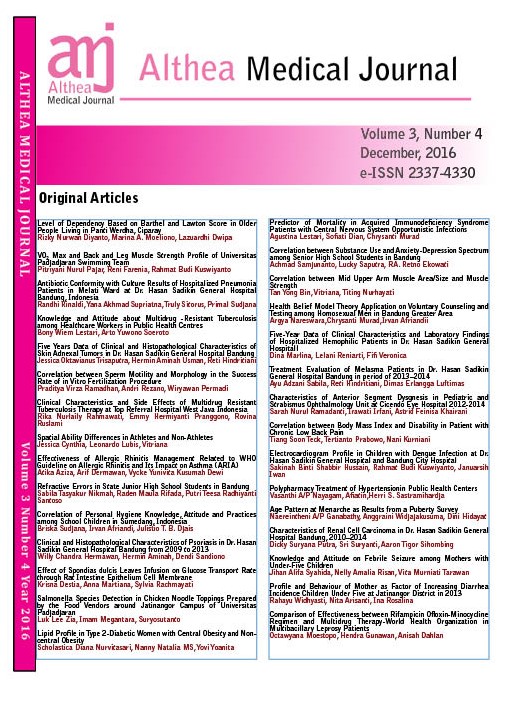
Polypharmacy Treatment of Hypertensionin Public Health Centers
Keywords:
Compliance, hypertension, polypharmacy, public health centerAbstract
Background: Hypertension is one of the most prominent global diseases. Despite the availability of effective therapies, hypertension remains poorly controlled in Indonesia. In many cases, patient’s noncompliance may be attributable to the low patients’ knowledge, attitude, and life-style practices such as polypharmacy. Polypharmacy is defined as the administration of many drugs at in one prescription. Polypharmacy increases expenses, possible adverse reaction to a single agent, incidence of drug interactions, and decreases patient’s compliance This study aimed to identify the practice of polypharmacy in hypertension treatment in primary health centers.
Methods: A cross-sectional descriptive observational study was carried out on 60 patients from two primary health centers in Jatinangor, West Java, Indonesia in October 2013. Sociodemographic profile, degree of hypertension, types of antihypertensive drugs, concomitant drugs given together with antihypertensive drugs, and treatment compliance data were collected and presented in tables and figures.
Results: The incidence of hypertension was more common among male patients compared to female patients. Thirty-three patients (55%) have low compliance to their medication. Twenty-nine patients (48%) received single drug and 31 patients (52%) received more than one drugs.
Conclusions: The percentage of polypharmacy practice in treating hypertension in primary health centers is 52%. The most frequently prescribed anti-hypertensive are angiotensin-converting enzyme (ACE) inhibitors and calcium-channel blockers (CCB). Most of hypertensive patients have low compliance to therapy. [AMJ.2016;3(4):633–9]
DOI: 10.15850/amj.v3n4.951
Downloads
Published
Issue
Section
License
- Authors retain copyright and grant Althea Medical Journal right of first publication with the work simultaneously licensed under a Creative Commons Attribution License that allows others to freely share and remix the work with an acknowledgement of the work's authorship and initial publication in Althea Medical Journal. Althea Medical Journal is licensed under CC BY-NC 4.0
- Authors are permitted to copy and redistribute the journal's published version of the work non-commercially (e.g., post it to an institutional repository or publish it in a book), with an acknowledgment of its initial publication in Althea Medical Journal.