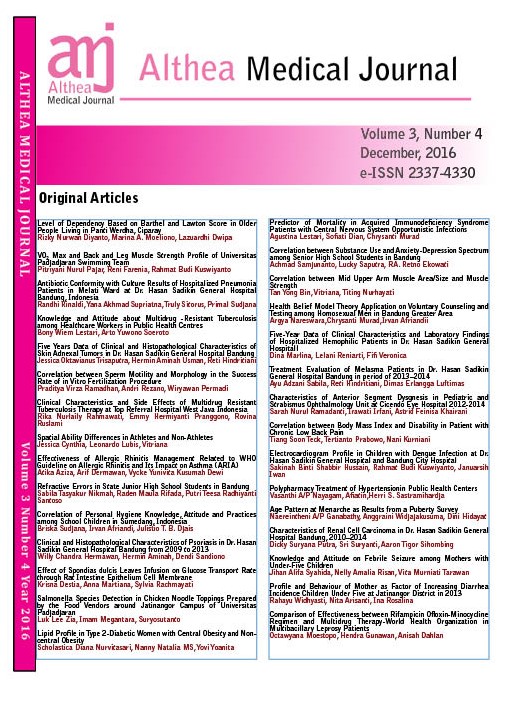
Antibiotic Conformity with Culture Results of Hospitalized Pneumonia Patients in Melati Ward at Dr. Hasan Sadikin General Hospital Bandung, Indonesia
Keywords:
Antibiotic, conforming group, nonconforming group, Klebsiella pneuomonia, pneumoniaAbstract
Background: Pneumonia is an infection with the highest mortality rate in Indonesian hospitals. According to The American Thoracic Society and The Infectious Diseases Society of America (ATS/IDSA), empirical use of antibiotics is still effective for pneumonia treatment. Inappropriate use of antibiotics would cause negative effects such as prolonged hospitalization, a high cost of treatment, and increased antibiotic-resistant bacteria. The goal of this study was to clarify the empirical use of antibiotic conformity with a bacteria culture.
Methods: This study was conducted from August to October 2013 using a descriptive retrospective method based on 116 medical records of pneumonia patients hospitalized in Melati Ward, Dr. Hasan Sadikin General Hospital Bandung during 2011–2012. The type of bacteria, conformity with antibiotics given to patients, and type of antibiotics were analyzed. The conformity of antibiotics was assessed based on the resistance test. If the results were sensitive, they would be put in the conforming group and in the non-conforming group if the results were resistant or intermediate. Data was derived with descriptive statistics, using percentage and frequency distribution, illustrated in tables and figures.
Results: Based on culture results and sensitivity of antibiotic empirical therapy given, 55.17% cases were conformed. The most widely used antibiotic group was Third-generation Cephalosporin (60.34%). The most common bacterias were Klebsiella pneumonia (34.5%) and Acinetobacter baumanni (13.8%).
Conclusions: Most of the antibiotics given to pneumonia patients are still appropriate with results of the bacteria culture test and resistance test. [AMJ.2016;3(4):504–8]
DOI: 10.15850/amj.v3n4.931
Downloads
Published
Issue
Section
License
- Authors retain copyright and grant Althea Medical Journal right of first publication with the work simultaneously licensed under a Creative Commons Attribution License that allows others to freely share and remix the work with an acknowledgement of the work's authorship and initial publication in Althea Medical Journal. Althea Medical Journal is licensed under CC BY-NC 4.0
- Authors are permitted to copy and redistribute the journal's published version of the work non-commercially (e.g., post it to an institutional repository or publish it in a book), with an acknowledgment of its initial publication in Althea Medical Journal.