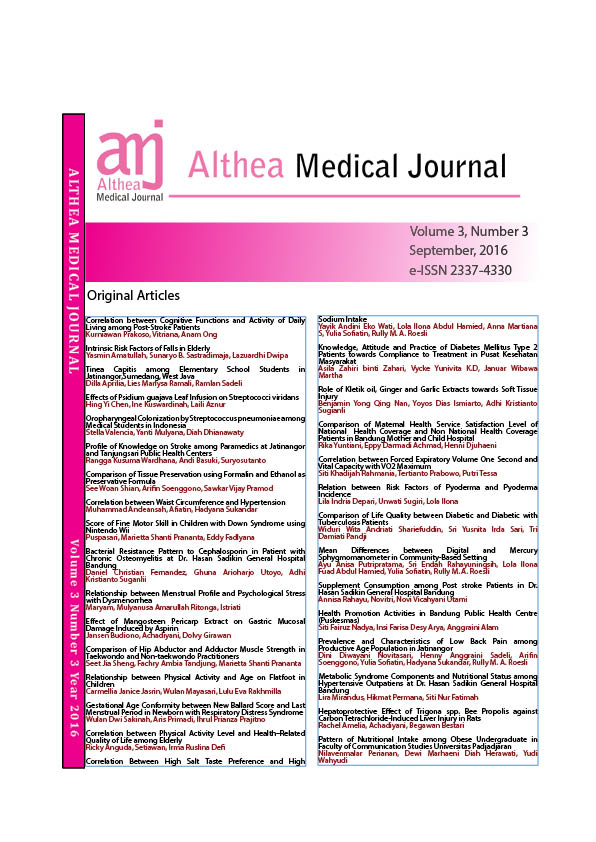
Correlation between Forced Expiratory Volume One Second and Vital Capacity with VO2 Maximum
Keywords:
Forced expiratory volume one second, maximum oxygen uptake, vital capacityAbstract
Background: Medical students need to cope with their tight schedule, which also demand a good physical fitness to do those activities. Insufficient leisure time and exhausting activities impede students’ capacity on having routine physical exercise to maintain their physical fitness. Cardiopulmonary endurance describes a person physical fitness level, and lung function is one basic component of cardiopulmonary endurance. Without optimal lung function, circulatory system in the body cannot work properly. This study aimed to determine whether lung function giving a significant correlation with the cardiorespiratory endurance which are measured by Forced Expiratory Volume One Second (FEV1), Vital Capacity (VC), and VO2Maximum (VO2max), respectively.
Methods: This study was conducted in September–October 2013 to the students of Faculty of Medicine at Universitas Padjadjaran academic year 2010–2012, using the cross-sectional method. Sample was taken through simple random sampling process. There were 34 male and 34 female students after controlling for covariates. Direct measurement using spirometer used to determine lung function and maximum oxygen uptake was measured by assessing Rhyming Step Test result. Correlation coefficient was then calculated by Pearson correlation test.
Results: The correlation between FEV1with VO2max of male students giving a value of p=0.442, while for VC obtained a value of p=0.259. Female students result giving a value of p=0.746 for the FEV1with VO2max, and p=0.489 for the VC with the VO2max.
Conclusions: There is no significant correlation between FEV1 and VC with the VO2max of the respondents. [AMJ.2016;3(3):430–3]
DOI: 10.15850/amj.v3n3.868
Downloads
Published
Issue
Section
License
- Authors retain copyright and grant Althea Medical Journal right of first publication with the work simultaneously licensed under a Creative Commons Attribution License that allows others to freely share and remix the work with an acknowledgement of the work's authorship and initial publication in Althea Medical Journal. Althea Medical Journal is licensed under CC BY-NC 4.0
- Authors are permitted to copy and redistribute the journal's published version of the work non-commercially (e.g., post it to an institutional repository or publish it in a book), with an acknowledgment of its initial publication in Althea Medical Journal.