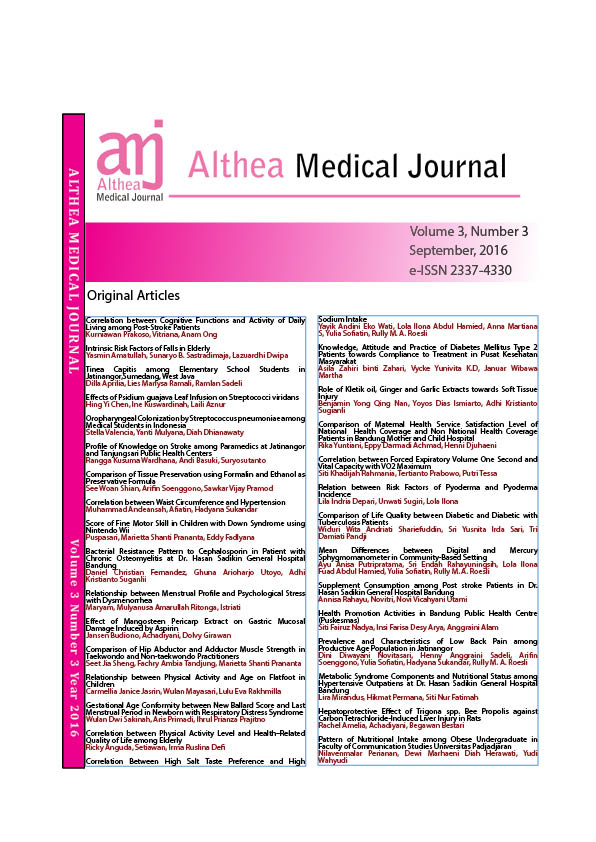
Pattern of Nutritional Intake among Obese Undergraduate in Faculty of Communication Studies Universitas Padjadjaran
Keywords:
Food pattern, obesity, undergraduateAbstract
Background: Obesity has become the 5th leading cause of death worldwide in 2010. It is a combination of genetic susceptibility, increased availability of high energy food intake and decreased requirements for physical activity in modern society. The increase in calorie intake among obese people often leads to many chronic diseases. Therefore, the aim of this study was to observe calorie intake pattern among obese undergraduates.
Methods: This study was conducted at Faculty of Communication Studies Universitas Padjadjaran, from September to November 2013. This cross-sectional study used anthropometric measurement based on Asian Body Mass cut-off points, which the screening was conducted on 512 undergraduate students, consisting of 103 undergraduates, overweight (50) and obese (53). From 53 undergraduates, 30 respondents were randomly selected. The respondents were then interviewed using 3x24 hours Food Recall questionnaire, conducted on two weekdays and one weekend to observe their pattern of nutritional intake. Total number of calories was categorized into few groups according to the Recommended Dietary Allowance (RDA) 2012.
Results: From the thirty obese undergraduates, both male (11) and female (9) consumed more excess protein in daily life. Consumption of carbohydrate and energy was significantly normal. Common consumption of food as daily basis contained more carbohydrate then protein, fats or energy.
Conclusions: Prevalence of obesity is still high. Frequent meal and high intake of carbohydrates has become factors to nutritional imbalance of obese undergraduates. Types of food most widely consumed are white rice, fried chicken, tofu, tempe (asian food made from fermenting soybeans) and sweetened tea. [AMJ.2016;3(3):486–92]
DOI: 10.15850/amj.v3n3.860
Downloads
Published
Issue
Section
License
- Authors retain copyright and grant Althea Medical Journal right of first publication with the work simultaneously licensed under a Creative Commons Attribution License that allows others to freely share and remix the work with an acknowledgement of the work's authorship and initial publication in Althea Medical Journal. Althea Medical Journal is licensed under CC BY-NC 4.0
- Authors are permitted to copy and redistribute the journal's published version of the work non-commercially (e.g., post it to an institutional repository or publish it in a book), with an acknowledgment of its initial publication in Althea Medical Journal.