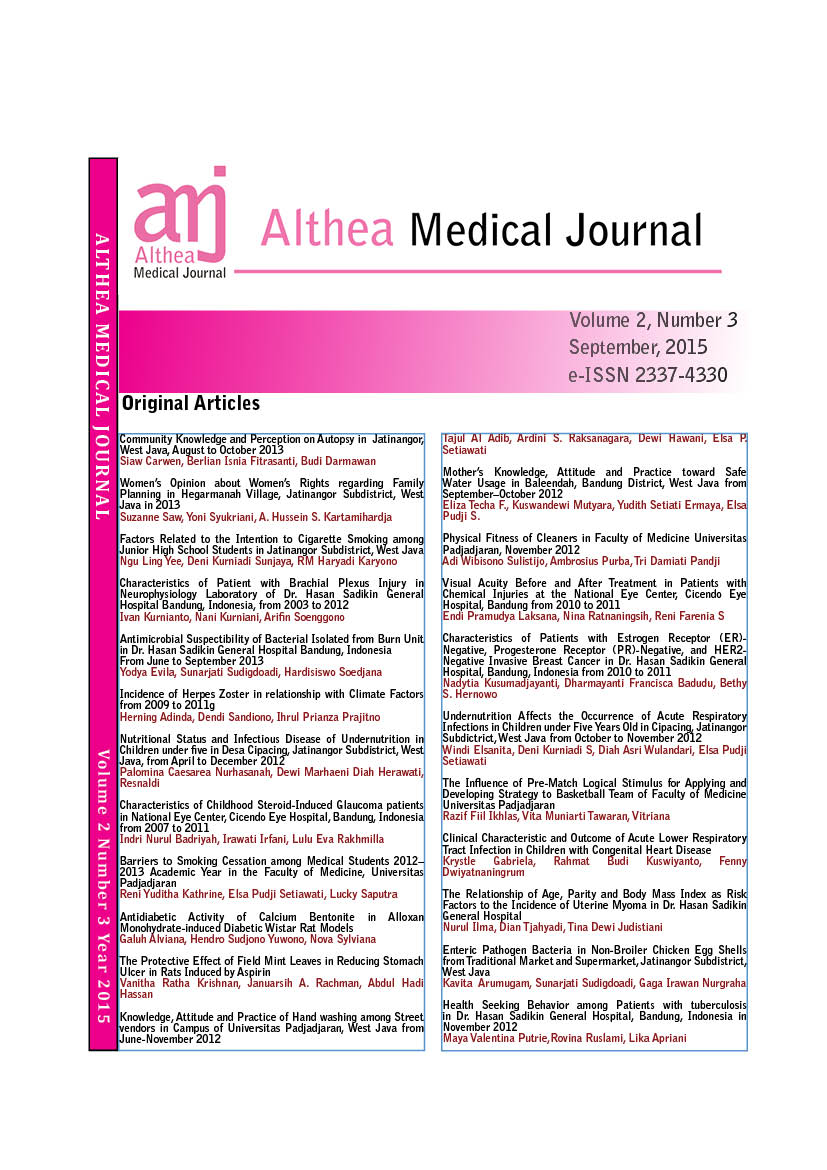
Women’s Opinion about Women’s Rights regarding Family Planning in Hegarmanah Village, Jatinangor Subdistrict, West Java in 2013
Keywords:
family planning, opinion, woman’s rightAbstract
Background: Universal Declaration of Human Rights stated that all mankind have equal right and dignity. Both woman and man have rights regarding family planning. It is often assumed that in developing country, women do not consider their rights in family planning decision making process. This study was carried out to determine the opinion of women regarding women’s rights in family planning.
Methods: A descriptive study was carried out to 99 respondents during the period of August to October 2013, in Hegarmanah village, Jatinangor subdistrict. The inclusion criteria were women aged 15–49 years old, able to speak Bahasa Indonesia, and agreed to participate. Variables for this study were the opinions of the respondents regarding woman’s rights in family planning which were represented in 12 questions. Collected data were presented as percentages shown in tables.
Results: Most of the respondents stated that they had the rights in family planning decision making, including choosing contraceptive methods, number of children, and spacing of each child. However, all of the respondents agreed that men should be involved in it. More than half of the respondents stated that they asked opinion from family member regarding family planning especially their mothers. Cultural norms did not influence the family planning decision making. However, religion influenced the family planning decision making.
Conclusions: Majority of the women in Hegarmanah village have the role to make decision on family planning by considering the opinions of their spouses, other family members, friends and their religions.
DOI: 10.15850/amj.v2n3.526
Downloads
Published
Issue
Section
License
- Authors retain copyright and grant Althea Medical Journal right of first publication with the work simultaneously licensed under a Creative Commons Attribution License that allows others to freely share and remix the work with an acknowledgement of the work's authorship and initial publication in Althea Medical Journal. Althea Medical Journal is licensed under CC BY-NC 4.0
- Authors are permitted to copy and redistribute the journal's published version of the work non-commercially (e.g., post it to an institutional repository or publish it in a book), with an acknowledgment of its initial publication in Althea Medical Journal.