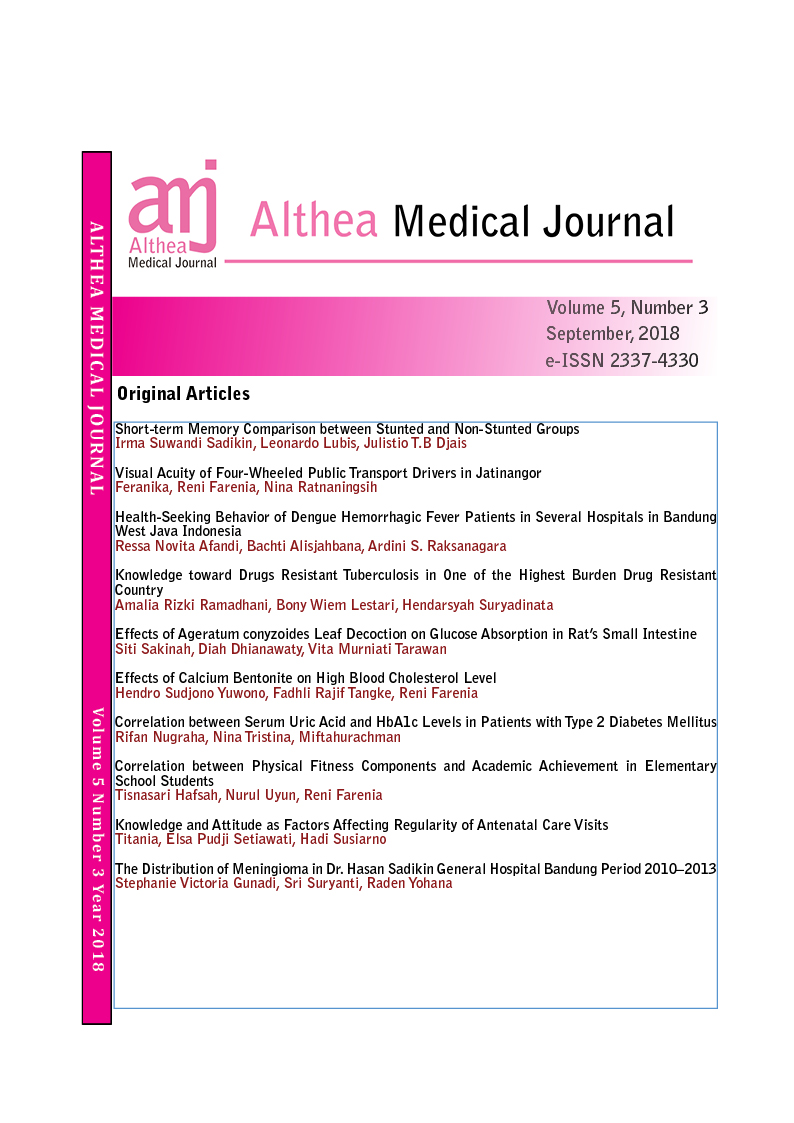
Correlation between Physical Fitness Components and Academic Achievement in Elementary School Students
DOI:
https://doi.org/10.15850/amj.v5n3.520Keywords:
Academic achievement, physical fitness, studentsAbstract
Background: Physical fitness is a degree of health status as a basic physical condition of someone to perform daily activity. Elementary school students should have a good physical fitness to obtain satisfactory academic achievement. The purpose of this study was to examine the correlation between physical fitness and academic achievement.
Methods: This study used an observational analytical method with cross-sectional design, conducted from September−October 2013, using total sampling method. There were 82 students of the 4th−6th- grade from Cikeruh 2 elementary school at Jatinangor. The school was chosen by random selection. The physical fitness assessment in this study consisted of step test to measure cardiorespiratory endurance, body mass index (BMI) for body composition, push-up for muscular strength and sit-up for muscular flexibility. Academic achievement was collected from the last examination result. Each component of physical fitness test results were converted to a score and then categorized.
Results: Most students (74.4%) had fair physical fitness, boys 68.3%, and girls 80.5%. No correlation was found between physical fitness and academic achievement (p=0.432 and r=0.162).
Conclusions: There is no significant correlation between physical fitness and academic achievement.
References
Giriwijoyo S. Ilmu faal olahraga: fungsi tubuh manusia pada olah raga. 1st ed. Bandung: FPOK UPI; 2007. p. 43.
LaMonte MJ, Barlow CE, Jurca R, Kampert JB, Church TS, Blair SN. Cardiorespiratory fitness is inversely associated with the incidence of metabolic syndrome. Circulation. 2005; 112 (4):505−12.
Gill JM, Malkova D. Physical activity, fitness and cardiovascular disease risk in adults: interactions with insulin resistance and obesity. Clin Sci (Lond).2006; 110(4):409−25.
Muhibin Syah ME. Psikologi pendidikan. 1st ed. Jakarta: Raja Grafinda Persada; 2003. p. 89.
Coe PW, Pivarnik JM, Womack CJ, Reeves MJ, Malina RM. Effect of physical education and activity levels on academic achievement in children. Med Sci Sports Exerc. 2006;38(8):1515−9.
Trudeau F, Shephard RJ. Physical education, school physical activity, school sports and academic perfomance. Int J Behav Nutr Phys Act. 2008;5(1):10−22.
Sabia JJ. The effect of body weight on adolescent academic perfomance. Southern Economic Journal. 2007; 73(4):871−900.
Maples WC. Visual factor that significantly impact academic perfomance. Optometry. 2003;74(1): 35−49.
Grissom JB. Physical fitness and academic achievement. JEPonline. 2005;8(1):11−25.
Eveland-Sayers BM, Farley RS, Fuller DK, Morgan DW, Caputo JL. Physical fitness and academic achievement in elementary school children. J Phys Act Health. 2009;6(1):99−104.
Ãlvarez-Bueno C, Pesce C, Cavero-Redondo I, et al. Academic Achievement and Physical Activity: A Meta-analysis. Pediatrics. 2017;140-6.
Asmare B, Taddele M, Berihun M and Wagnew F. Nutritional status and correlation with academic performance among primary school children, northwest Ethiopia. BMC Res Notes. 2018;11:805.
WHO intl. WHO child growth reference 2007. Available at https://www.who.int/growthref/en.
Downloads
Published
Issue
Section
License
- Authors retain copyright and grant Althea Medical Journal right of first publication with the work simultaneously licensed under a Creative Commons Attribution License that allows others to freely share and remix the work with an acknowledgement of the work's authorship and initial publication in Althea Medical Journal. Althea Medical Journal is licensed under CC BY-NC 4.0
- Authors are permitted to copy and redistribute the journal's published version of the work non-commercially (e.g., post it to an institutional repository or publish it in a book), with an acknowledgment of its initial publication in Althea Medical Journal.