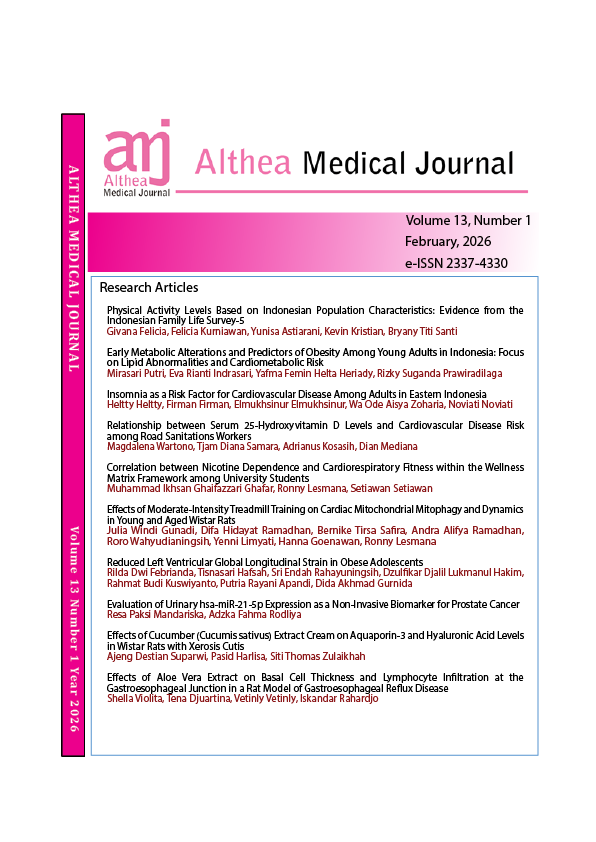
Effects of Moderate-Intensity Treadmill Training on Cardiac Mitochondrial Mitophagy and Dynamics in Young and Aged Wistar Rats
DOI:
https://doi.org/10.15850/amj.v13n1.4553Keywords:
Aging, exercise training, gene expression, mitophagy, mitochondrial dynamicsAbstract
Background: Cardiac aging is closely associated with mitochondrial dysfunction and impaired quality control mechanism. Exercise has been shown to modulate mitochondrial homeostasis, however, its effects on cardiac mitophagy and mitochondrial dynamics during aging remain unclear. This study investigated the effects of moderate-intensity treadmill training on mitochondrial maintenance-related gene expression in the hearts of young and aged Wistar rats.
Methods: Young and aged rats were divided into four groups: young control, young exercise, aged control, and aged exercise (n=6 per group). Exercise groups performed treadmill running at 20 m/min for 30 minutes/day, 5 days/week for 8 weeks. Cardiac gene expression levels of Pink1, Parkin, Mfn1, Mfn2, Opa1, Drp1, and Fis1 were analyzed using semi-quantitative polymerase chain reaction (PCR). Data were analyzed using one-way ANOVA or Kruskal–Wallis test followed by appropriate post hoc analyses.
Results: Exercise significantly increased Mfn2 expression in aged exercise rats compared with aged controls (p=0.029), suggesting partial restoration of age-related decline. Expression of Mfn1 and Drp1 varied among groups but showed no significant pairwise differences. Expression levels of Opa1, Fis1, Pink1, and Parkin remained unchanged. These results indicate that moderate exercise selectively enhances mitochondrial fusion capacity while maintaining balanced fission and basal mitophagy activity.
Conclusion: Moderate-intensity treadmill training promotes mitochondrial fusion-related adaptation in aging cardiac tissue. Regular moderate exercise may represent a potential non-pharmacological strategy to support mitochondrial function and mitigate cardiovascular aging.
Downloads
Published
Issue
Section
License
- Authors retain copyright and grant Althea Medical Journal right of first publication with the work simultaneously licensed under a Creative Commons Attribution License that allows others to freely share and remix the work with an acknowledgement of the work's authorship and initial publication in Althea Medical Journal. Althea Medical Journal is licensed under CC BY-NC 4.0
- Authors are permitted to copy and redistribute the journal's published version of the work non-commercially (e.g., post it to an institutional repository or publish it in a book), with an acknowledgment of its initial publication in Althea Medical Journal.