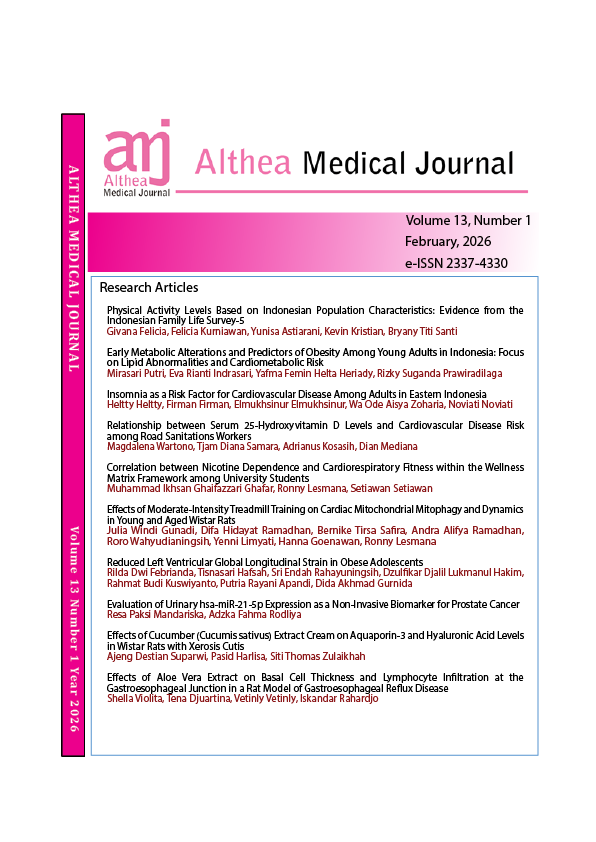
Physical Activity Levels Based on Indonesian Population Characteristics: Evidence from the Indonesian Family Life Survey-5
DOI:
https://doi.org/10.15850/amj.v13n1.4273Keywords:
IFLS-5, lifestyle factors, physical activity, sedentary behaviorAbstract
Background: According to the World Health Organization, approximately 80% of the global population is physically inactive. Sedentary behavior is a major contributor to the increasing risk of chronic diseases. This study aimed to describe physical activity levels among the Indonesian population and examine their associations with sociodemographic and lifestyle factors.
Methods: This cross-sectional study was conducted from March to November 2024 using secondary data from the Indonesian Family Life Survey-5 (IFLS-5). Variables analyzed included age, gender, ethnicity, marital status, body mass index (BMI), perceived health status, occupation, education level, residence, sleep quality, smoking status, and physical activity level. A total of 4,156 respondents were included. Associations between population characteristics and physical activity levels were examined using the chi-square test.
Results: Nearly half of the respondents engaged in light physical activity (47.8%), followed by moderate (28.0%) and vigorous physical activity (24.2%). Significant associations were found between physical activity levels and age (p=0.015), gender (p<0.001), ethnicity (p=0.006), occupation (p<0.001), education level (p<0.001), residence (p<0.001), sleep quality (p<0.001), and smoking status (p<0.001). Agricultural workers (46.7%) and individuals with severe sleep disturbances (40.0%) were more likely to engage in vigorous physical activity.
Conclusion: Most Indonesians engage predominantly in light physical activity. Several sociodemographic and lifestyle factors are significantly associated with physical activity levels, underscoring the importance of promoting healthier and more active lifestyles.
Downloads
Published
Issue
Section
License
- Authors retain copyright and grant Althea Medical Journal right of first publication with the work simultaneously licensed under a Creative Commons Attribution License that allows others to freely share and remix the work with an acknowledgement of the work's authorship and initial publication in Althea Medical Journal. Althea Medical Journal is licensed under CC BY-NC 4.0
- Authors are permitted to copy and redistribute the journal's published version of the work non-commercially (e.g., post it to an institutional repository or publish it in a book), with an acknowledgment of its initial publication in Althea Medical Journal.