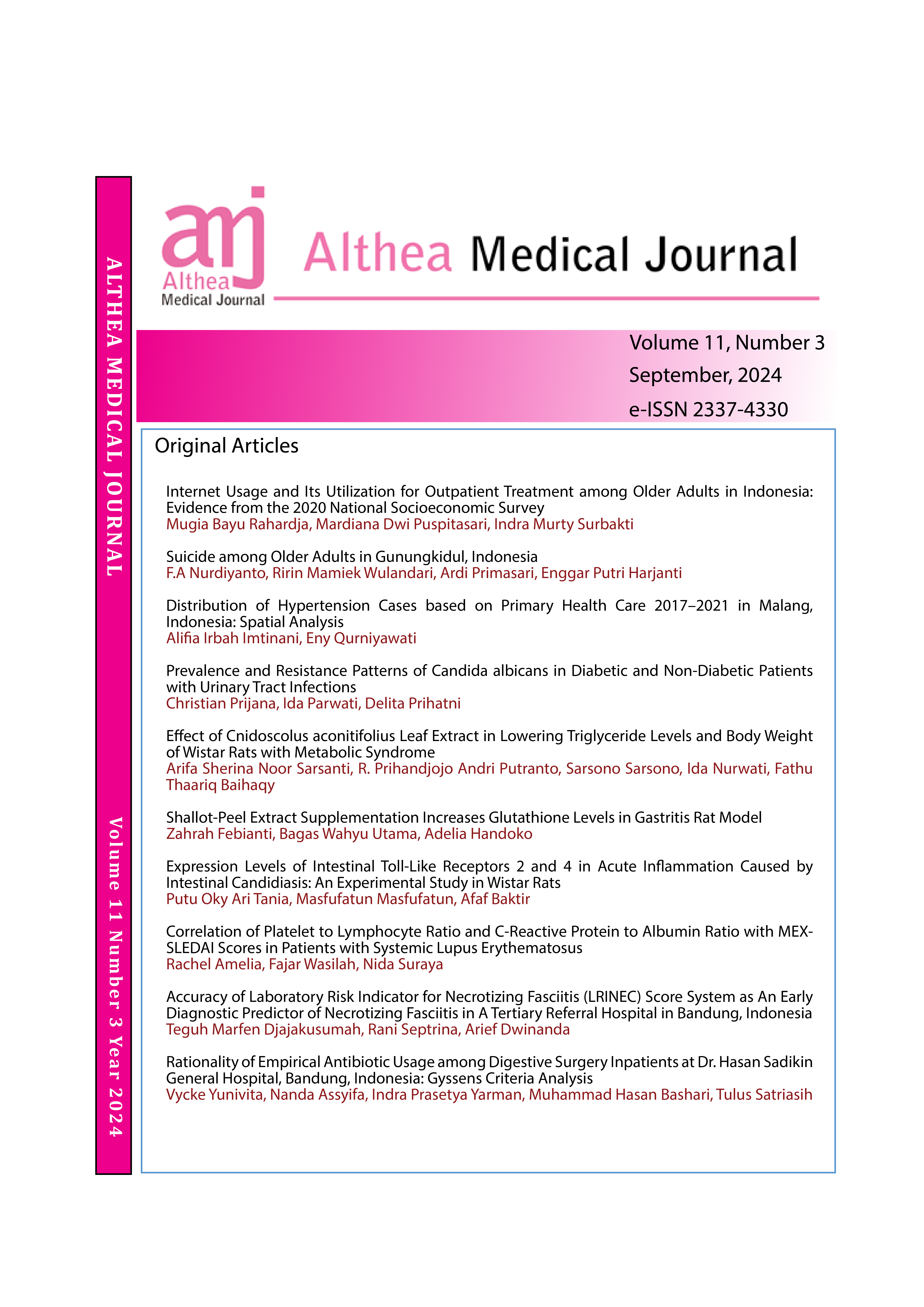
Expression Levels of Intestinal Toll-Like Receptors 2 and 4 in Acute Inflammation Caused by Intestinal Candidiasis: An Experimental Study in Wistar Rats
DOI:
https://doi.org/10.15850/amj.v11n3.3345Keywords:
Candida albicans, candidiasis, inflammation, intestinal, TLR2, TLR4Abstract
Background: Candida albicans grows in the gastrointestinal tract as a normal microflora that may cause intestinal candidiasis, characterized by formation of biofilm and inflammation. Candida is recognized by toll-like receptors (TLRs). This study aimed to explore the relationship between intestinal TLR 2 and TLR 4 expression levels in candidiasis at each phase of inflammation.
Methods: An experimental study was performed using a simple randomized sampling on 30 male Wistar rats divided into a control and a treatment group. Each group was inoculated with Candida albicans. Dysbiosis conditions were designed in the treatment group using multiple antibiotics and on day 5 the rats were injected with subcutaneous cortisone acetate. The groups were terminated in five different times (days 7, 14, 21, 28 and 35). On the termination day, intestinal tissue was isolated and the TLR 2 and TLR 4 expression were analyzed by immunohistochemistry. The data were analyzed by parametric test with SPSS (p<0.05) and completed by post-hoc test Least Significance Difference (LSD) to compare pairs of groups.
Results: The expression of TLR 2 and TLR 4 between control and treatment groups showed significant differences (p=0.005). In the treatment group, there was a gradual increase in the TLR2 and TLR 4 expressions. Positive expression of TLR appeared more in the submucosal or basal area than apical surface. The treatment group showed the highest expression of both TLR2 (82.37%) and TLR4 (87.40%) on termination day 35.
Conclusions: Inflammation caused by intestinal candidiasis can result in increased expression of intestinal TLR2 and 4 contributing to an increased risk of biofilm formation.
Downloads
Published
Issue
Section
License
- Authors retain copyright and grant Althea Medical Journal right of first publication with the work simultaneously licensed under a Creative Commons Attribution License that allows others to freely share and remix the work with an acknowledgement of the work's authorship and initial publication in Althea Medical Journal. Althea Medical Journal is licensed under CC BY-NC 4.0
- Authors are permitted to copy and redistribute the journal's published version of the work non-commercially (e.g., post it to an institutional repository or publish it in a book), with an acknowledgment of its initial publication in Althea Medical Journal.