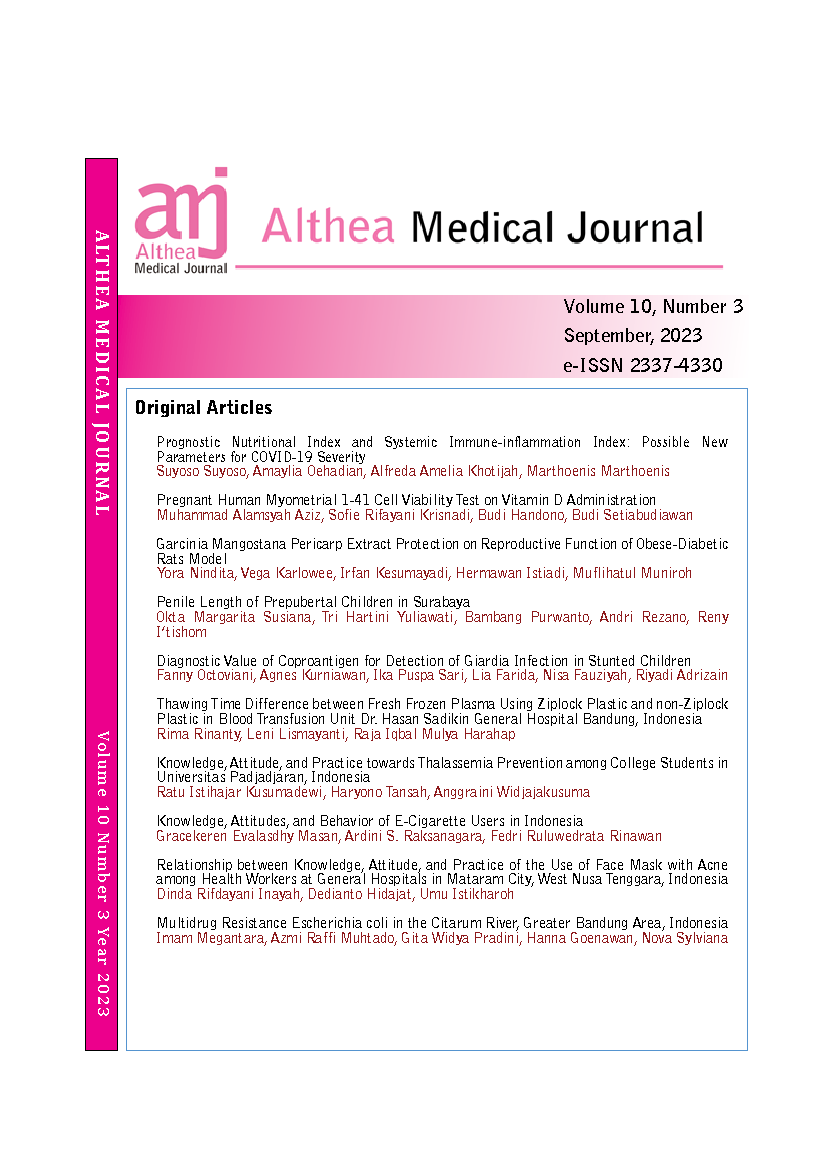
Penile Length of Prepubertal Children in Surabaya
DOI:
https://doi.org/10.15850/amj.v10n3.3094Keywords:
Body mass index, micropenis, penile circumference, phallic size, short statureAbstract
Background: Early recognition of phallic size abnormalities is essential to identify underlying endocrine and genetic disorders. Parents are concerned regarding their son’s penis length, especially obese and short-stature boys. This study aimed to investigate the factors of penile length in prepubertal boys aged 9-11 in Surabaya.
Methods: A cross-sectional analytic observational study was conducted between October and November 2021 during the community services program of the Andrology Study Program, Universitas Airlangga. One hundred forty-eight healthy boys aged 9-11 years were enrolled in this study. Penile parameters and anthropometric measures were recorded. Data were analyzed with Spearman Rho’s formula to correlate the variables studied.
Results: The average penile lengths and penile circumference of the penis were 6.3±1.4 and 5.2±1.0 cm, respectively. This study found two boys with micropenis (1.35%) with normal and overweight body mass index (BMI). The penile length was positively correlated with height but not with BMI.
Conclusion: Androgen and growth hormones significantly influence penile length. Children with abnormal BMI tend to have smaller penile sizes, associated with increasing androgen aromatization.
References
- Teckchandani N, Bajpai M. Penile length nomogram for Asian Indian prepubertal boys. J Pediatr Urol. 2014;10(2):352–4.
- Cimador M, Catalano P, Ortolano R, Giuffre M. The inconspicuous penis in children. Nat Rev Urol. 2015;12(4):205–15.
- Palmer L, Palmer J. Management of abnormalities of the external genitalia in boys. In: Partin AW, editor. Campbell-Walsh-Wein urology. 12th Ed. Philadelphia: Elsevier; 2020. p. 877–80.
- Park S, Chung JM, Kang D Il, Ryu DS, Cho WY, Lee SD. The change of stretched penile length and anthropometric data in Korean children aged 0-14 years: Comparative study of last 25 years. J Korean Med Sci. 2016;31(10):1631–4.
- Park SK, Ergashev K, Chung JM, Lee SD. Penile circumference and stretched penile length in prepubertal children: A retrospective, single-center pilot study. Investig Clin Urol. 2021;62(3):324–30.
- Maulana IS, Kalew R, Mainase J, Mellyana, Atmanegara K. Hubungan panjang penis dengan indeks massa tubuh pada anak usia 6–8 tahun. Pameri. 2019;1(1):11–8.
- Adriansyah R, Ali M, Hakimi H, Deliana M, Lubis SM. The relationship of body mass index to penile length and testicular volume in adolescent boys. Paediatr Indones. 2012;52(5):267–71.
- Hatipoǧlu N, Kurtoǧlu S. Micropenis: etiology, diagnosis and treatment approaches. J Clin Res Pediatr Endocrinol. 2013;5(4):217–23.
- Zalel Y, Pinhas-Hamiel O, Lipitz S, Mashiach S, Achiron R. The development of the fetal penis-an in utero sonographic evaluation. Ultrasound Obstet Gynecol. 2001;17(2):129–31.
- Lee PA, Mazur T, Houk CP, Blizzard RM. Growth hormone deficiency causing micropenis: lessons learned from a well-adjusted adult. Pediatrics. 2018;142(1):e20174168.
- Rezakhaniha S, Rezakhaniha B, Aarabi N, Siroosbakht S. Is it necessary to weight loss in obese boys with small penile length? a case-control study. J Compr Pediatr. 2020;11(4):e107272.
- Bouvattier C. Micropenis. Arch Pediatr. 2014;21(6):665–9.
- Gaither TW, Allen IE, Osterberg EC, Alwal A, Harris CR, Breyer BN. Characterization of genital dissatisfaction in a national sample of U.S. men. Arch Sex Behav. 2017;46(7):2123–30.
- Kementerian Kesehatan Republik Indonesia. Epidemi obesitas. Jakarta: Kementerian Kesehatan Republik Indonesia; 2018.
- Aulia M, Saputra R, Tanzila RA, Arsyad KHM. Angka kejadian mikropenis pada anak usia 3–5 tahun di TK Chiqa Smart dan TK Al-Fashtha Palembang. Masker Med. 2017;5(2):413–7.
- Veale D, Miles S, Bramley S, Muir G, Hodsoll J. Am I normal? A systematic review and construction of nomograms for flaccid and erect penis length and circumference in up to 15,521 men. BJU Int. 2015;115(6):978–86.
- Lynn R. Rushton’s r–K life history theory of race differences in penis length and circumference examined in 113 populations. Personality Individ Differ. 2013;55(3):261–6.
- Wang YN, Zeng Q, Xiong F, Zeng, Y. Male external genitalia growth curves and charts for children and adolescents aged 0 to 17 years in Chongqing, China. Asian J Androl. 2018;20(6):567–71.
- Narinder T, Minu B. Penile length nomogram for Asian Indian prepubertal boys. J Pediatr Urol. 2014;10(2):352–4.
- Nguyen Hoai B, Pham Minh Q, Nguyen Cao T, Sansone A, Colonnello E, Jannini EA. Data from 14,597 penile measurements of vietnamese men. Andrology. 2021;9(3):906–15.
- Mushannen T, Cortez P, Stanford FC, Singhal V. Obesity and hypogonadism- a narrative review highlighting the need for high-quality data in adolescents. Children (Basel). 2019;6(5):63.
- Liu Y, Ding Z. Obesity, a serious etiologic factor for male subfertility in modern society. Reproduction. 2017;154(4):R123–31.
- Cinaz P, Yeşilkaya E, Onganlar YH, Boyraz M, Bideci A, Çamurdan O, et al. Penile anthropometry of normal prepubertal boys in Turkey. Acta Paediatr. 2012;101(1):e33–6.
- Soydan H, Akyol İ, Ates F, Yilmaz O, Dursun F, Baykal K. Cross-sectional analysis of penile length in males 13 to 15 years old according to pubertal development stages. J Urol. 2012;188(4):1319–23.
Downloads
Published
Issue
Section
License
- Authors retain copyright and grant Althea Medical Journal right of first publication with the work simultaneously licensed under a Creative Commons Attribution License that allows others to freely share and remix the work with an acknowledgement of the work's authorship and initial publication in Althea Medical Journal. Althea Medical Journal is licensed under CC BY-NC 4.0
- Authors are permitted to copy and redistribute the journal's published version of the work non-commercially (e.g., post it to an institutional repository or publish it in a book), with an acknowledgment of its initial publication in Althea Medical Journal.