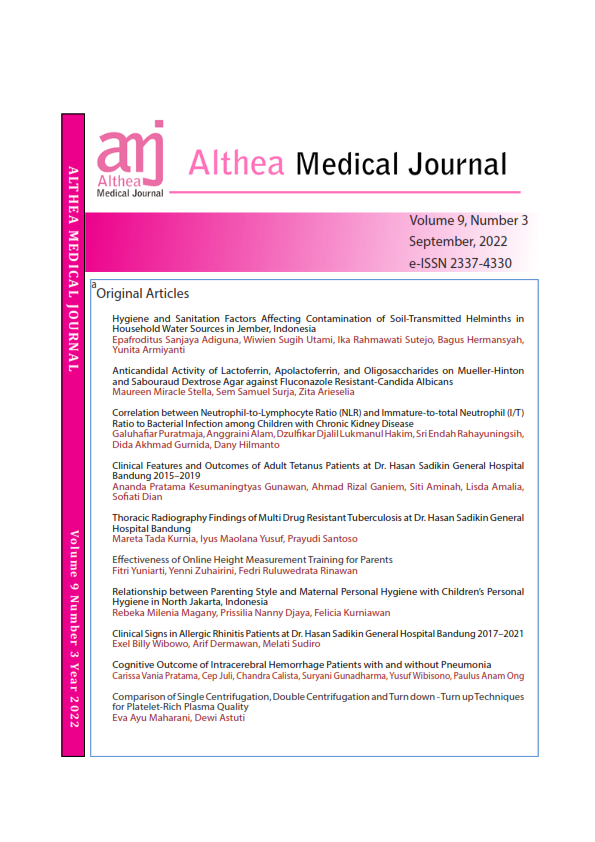
Comparison of Single Centrifugation, Double Centrifugation and Turn down-Turn up Techniques for Platelet-Rich Plasma Quality
DOI:
https://doi.org/10.15850/amj.v9n3.2628Keywords:
Blood cells count, centrifugation, PRPAbstract
Background: Platelet-rich plasma (PRP) is a new concept used in medical world, especially for wound healing. The main process that affects the PRP quality is the centrifugation process. This study aimed to assess the PRP separation process and determine the best technique of various centrifugation process.
Methods: This experimental study used acid citrate dextrose (ACD) blood taken from 11 healthy respondents and compared three-techniques including the single centrifugation (SC), the double centrifugation (DC), and the double centrifugation turn down - turn up (DC-TDTU) techniques. The quality of PRP was measured based on blood cells count (platelet, leukocyte, erythrocyte count, and Ht value) at each stage of centrifugation. The examination was carried out in 2021 at the Hematology Laboratory, Poltekkes Jakarta 3.
Results: The mean values of platelets, leukocytes, and Ht were increased in PRP compared to plasma supernatant both using the DC and DC-TDTU techniques, wherase the SC technique decreased in plasma compared with whole blood. When the procedures using DC and DC-TDTU are carried out properly, platelets would be concentrated in the second centrifugation. However, some erythrocyte and leukocyte contamination occurred by DC-TDTU technique compared to the DC technique.
Conclusion: The double centrifugation technique is the best Platelet-rich plasma separation technique compared to the DC-TDTU and SC techniques.
Downloads
Published
Issue
Section
License
- Authors retain copyright and grant Althea Medical Journal right of first publication with the work simultaneously licensed under a Creative Commons Attribution License that allows others to freely share and remix the work with an acknowledgement of the work's authorship and initial publication in Althea Medical Journal. Althea Medical Journal is licensed under CC BY-NC 4.0
- Authors are permitted to copy and redistribute the journal's published version of the work non-commercially (e.g., post it to an institutional repository or publish it in a book), with an acknowledgment of its initial publication in Althea Medical Journal.