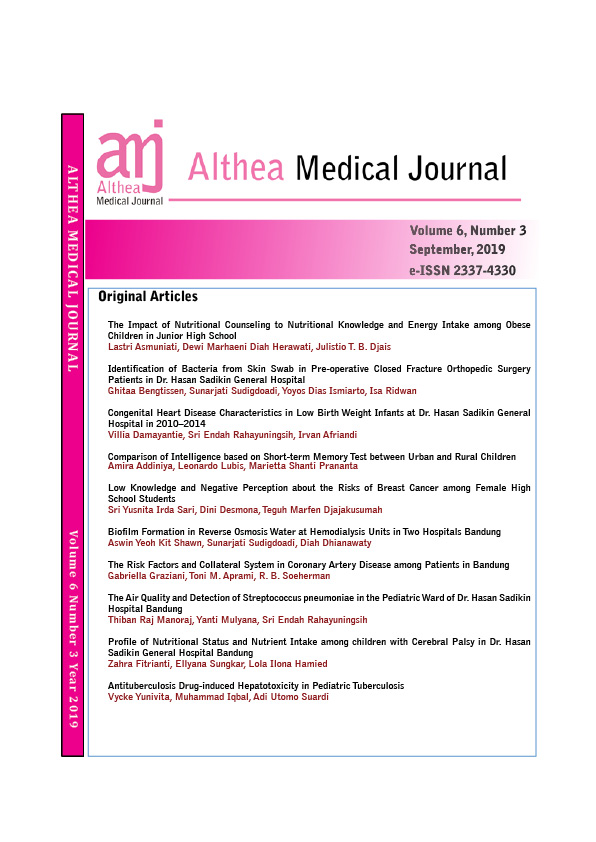
The Air Quality and Detection of Streptococcus pneumoniae in the Pediatric Ward of Dr. Hasan Sadikin Hospital Bandung
DOI:
https://doi.org/10.15850/amj.v6n3.1694Keywords:
Air quality, pediatric ward, Streptococcus pneumoniaeAbstract
Background: Nosocomial infection can be acquired by inhalation of droplets from contaminated air. In children, nosocomial pneumonia is mainly caused by Streptococcus pneumoniae. This study aimed to explore the air quality level and to detect Streptococcus pneumonia in the air of the Pediatric Ward of Dr. Hasan Sadikin Hospital, Bandung.
Methods: This was an observational descriptive study conducted in the Pediatric Ward of Dr. Hasan Sadikin Hospital in November 2012. The different number of modified tryptic soy agar (TSA) plates with 4% blood were exposed and placed in various rooms of the ward for 30 minutes between 12.00 pm to 1.00 pm at heights between 1.0m to 1.5m and according to the respectively room air volume. After exposure, these plates were then incubated for 48 hours at 35°C. The Colony Forming Units (CFU) on each plate was counted per Replicate Organism Detection and Counting (RODACTM). Detection of Streptococcus pneumonia was performed by detecting any round α-hemolytic colonies on the TSA plate, confirmed by Gram staining, optochin susceptibility test, and the bile solubility test.
Result: The air quality in 13 rooms of the Pediatric Ward was generally poor ranging from 27.5 to 232.0 CFU/30 min, however, the concentration of microorganisms per cubic meter air was from 0.198 to 4.296 CFU/m3. Moreover, Streptococcus pneumoniae was not present in the air of the ward.
Conclusions: Although Streptococcus pneumoniae has not been detected, the air quality in the Pediatric Ward of Dr. Hasan Sadikin Hospital, Bandung is generally poor. General precautions need to be enhanced to increase the air quality in the hospital.
References
ndex variation across British Columbia. Interior Health. 2010 [cited 2013 January 29]. Available from: https://www2.gov.bc.ca/assets/gov/environment/air-land-water/air/reports-pub/aqhi-variation-bc.pdf
Leung M, Chan AH. Control and management of hospital indoor air quality. Med Sci Monit. 2006;12(3):SR17–23.
Sadler TW. Langman’ s Medical Embryology. 11th ed. Philadelphia: Lippincott Williams & Wilkins; 2009. p. 206.
Ducel G, Fabry J, Nicolle L. Prevention of hospital acquired infections: a practical guide. Med J Armed Forces India. 2004;60(3):312.
Tablan OC, Anderson LJ, Besser R, Bridges C, Hajjeh R, et al. Guidelines for preventing healthcare-associated pneumonia, 2003: recommendations of CDC and the Healthcare Infection Control Practices Advisory Committee. MMWR Recomm Rep. 2004;53(RR-3):1–36.
Wardlaw T, Johansson EW, Hodge M. Pneumonia:the forgotten killer of children. Geneva: UNICEF/WHO; 2006.
Departemen Kesehatan Republik Indonesia. Profil Kesehatan Indonesia 2007. Jakarta:Departemen Kesehatan Republik Indonesia; 2008.
Brooks GF, Carroll KC, Butel JS, Morse SA. Jawetz, Melnick & Adelberg’s Medical Microbiology. 24th ed. McGraw-Hill Companies; 2007. p. 241-243
Becton, Dickinson and Company. BBLTM Prepared RODACTM Plates. Spark, MD, USA: Becton, Dickinson and Company; 2005. [downloaded on 22 March 2012] Available at: http://legacy.bd.com/ds/technicalCenter/inserts/8835631JAA(0205).pdf.
Shimeld LA, Rodgers AT. Essentials of diagnostic microbiology. Clifton Park, United States: Delmar Cengage Learning; 1999. p 117-130.
Kaijalainen T. The identification of Streptococcus pneumoniae. Volumes 11. Oulu, Finland: National Public Health Institute; 2006. p. 32.
Perilla MJ, Ajello G, Bopp C, Elliot J, Facklam R, Knapp JS, et al. Manual for the laboratory identification and antimicrobial susceptibility testing for bacterial pathogens of public health importance in the developing world: Haemophilus influenzae, Neisseria meningitidis, Streptococcus pneumoniae, Neisseria gonorrhoea, Salmonella typhi, Shigella, and Vibrio cholerae. Geneva: CDS Information Resource Center, WHO; 2003.
Downloads
Published
Issue
Section
License
- Authors retain copyright and grant Althea Medical Journal right of first publication with the work simultaneously licensed under a Creative Commons Attribution License that allows others to freely share and remix the work with an acknowledgement of the work's authorship and initial publication in Althea Medical Journal. Althea Medical Journal is licensed under CC BY-NC 4.0
- Authors are permitted to copy and redistribute the journal's published version of the work non-commercially (e.g., post it to an institutional repository or publish it in a book), with an acknowledgment of its initial publication in Althea Medical Journal.