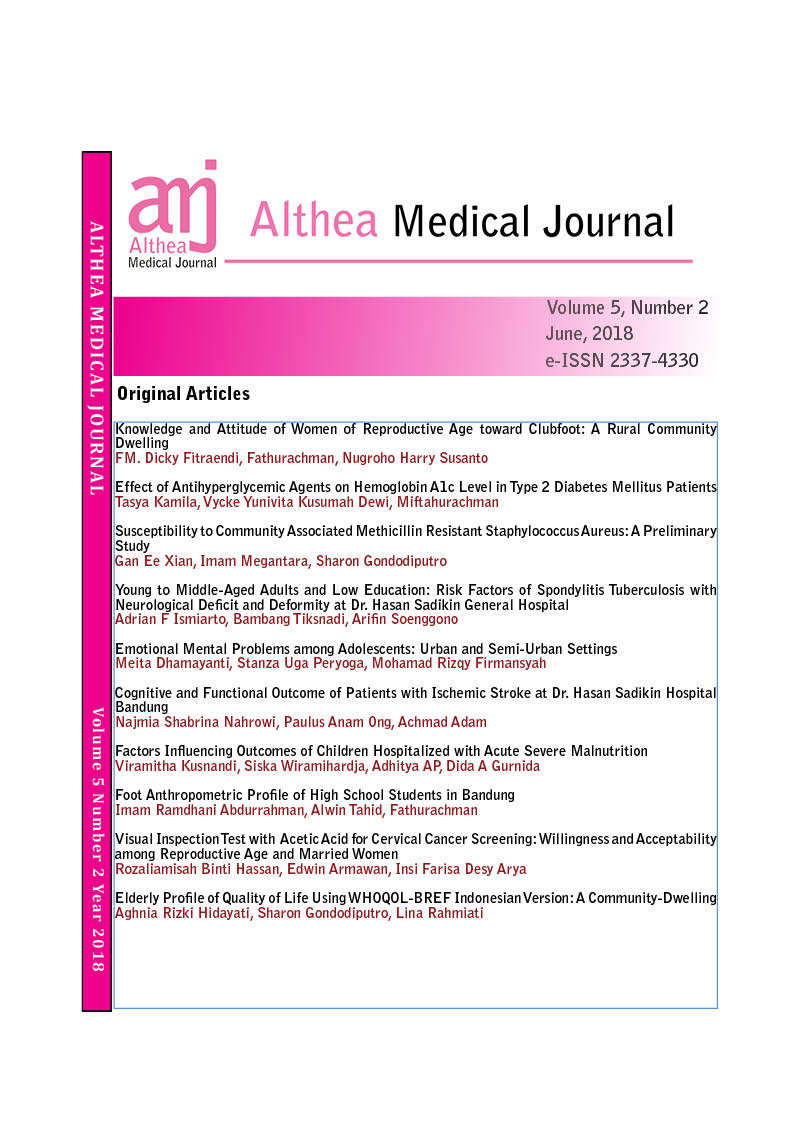
Susceptibility to Community Associated Methicillin Resistant Staphylococcus Aureus: A Preliminary Study
DOI:
https://doi.org/10.15850/amj.v5n2.1415Keywords:
Community associated methicillin resistant Staphylococcus aureus, community associated methicillin sensitive Staphylococcus aureus, nasal swabAbstract
Background: The Staphylococcus aureus infection is a leading cause of infection around the world. Due to the introduction of antibiotics, a strain called Methicillin-resistant S. aureus (MRSA) has emerged and occured in hospitalized patients worldwide. However around 1990, this infection had been detected among healthy people in the community without previous health care contact, known as community associated MRSA (CA-MRSA). The objectives of this study was to identify the susceptibility to CA-MRSA among people who came to Puskesmas Jatinangor, West Java, Indonesia.
Methods: A descriptive study using purposive sampling was carried out from September to October 2014 with data obtained through anterior nasal swab of 65 patients from Puskesmas Jatinangor who fulfilled the exclusion and inclusion criteria. Samples were transported to the microbiology lab of Faculty of Medicine Universitas Padjadjaran and planted on blood agar for culturing, then identified through gram staining, catalase and coagulase tests. Lastly tested for antibiotic resistance and the zone of inhibition measuring ≤21mm were classified as positive MRSA. The collected data were presented using tables.
Results: Out of 65 samples that were collected and tested, 17 samples (26%) were Staphylococcus aureus (S. aureus) carriers; 6 samples (9%) were positive with MRSA isolates; 6/17 of the S. aureus are MRSA.
Conclusions: People who come to Puskesmas Jatinangor show a significantly high proportion of susceptibility to CA-MRS.
References
DeLeo FR, Otto M, Kreiswirth BN, Chambers HF. Community-associated meticillin-resistant Staphylococcus aureus. Lancet. 2010;375(9725):1557‒68.
Otter JA, French GL. Community-associated meticillin-resistant Staphylococcus aureus strains as a cause of healthcare-associated infection. J Hosp Infect. 2011;79(3):189‒93.
Lestari ES, Severin JA, Filius PM, Kuntaman K, Duerink DO, Hadi U, et al. Antimicrobial resistance among commensal isolates of Escherichia coli and Staphylococcus aureus in the Indonesian population inside and outside hospitals. Eur J Clin Microbiol Infect Dis. 2008;27(1):45‒51.
Ramana KV, Mohanty SK, Wilson CG. Staphylococcus aureus colonization of anterior nares of school going children. Indian J Pediatr. 2009;76(8):813‒6.
Chambers HF, Deleo FR. Waves of resistance: Staphylococcus aureus in the antibiotic era. Nat Rev Microbiol. 2009;7(9):629‒41.
Barton M, Hawkes M, Moore D, Conly J, Nicolle L, Allen U, et al. Guidelines for the prevention and management of community-associated methicillin-resistant Staphylococcus aureus: A perspective for Canadian health care practitioners. Can J Microbiol. 2006;17(Suppl C):4C‒24C.
Kuehnert MJ, Kruszon-Moran D, Hill HA, McQuillan G, McAllister SK, Fosheim G, et al. Prevalence of Staphylococcus aureus nasal colonization in the United States, 2001-2002. J Infect Dis. 2006;193(2):172‒9.
Donabedian SM, Moore CL, Perri MB, Chua T, Zervos MJ. Do laboratory characteristics predict outcome in methicillin-resistant staphylococcus aureus bacteremia? Clin Microbiol Infect. 2009;15(s4):1860.
Ray P, Gautam V, Singh R. Methicillin-resistant staphylococcus aureus in developed and developing countries: Implications and solutions. Regional Health Forum (WHO/SEARO). 2011;15:74‒82.
Liu C, Bayer A, Cosgrove SE, Daum RS, Fridkin SK, Gorwitz RJ, et al. Clinical practice guidelines by the infectious diseases society of america for the treatment of methicillin-resistant Staphylococcus aureus infections in adults and children. Clin Infect Dis. 2011;52(3):18‒55.
Downloads
Published
Issue
Section
License
- Authors retain copyright and grant Althea Medical Journal right of first publication with the work simultaneously licensed under a Creative Commons Attribution License that allows others to freely share and remix the work with an acknowledgement of the work's authorship and initial publication in Althea Medical Journal. Althea Medical Journal is licensed under CC BY-NC 4.0
- Authors are permitted to copy and redistribute the journal's published version of the work non-commercially (e.g., post it to an institutional repository or publish it in a book), with an acknowledgment of its initial publication in Althea Medical Journal.